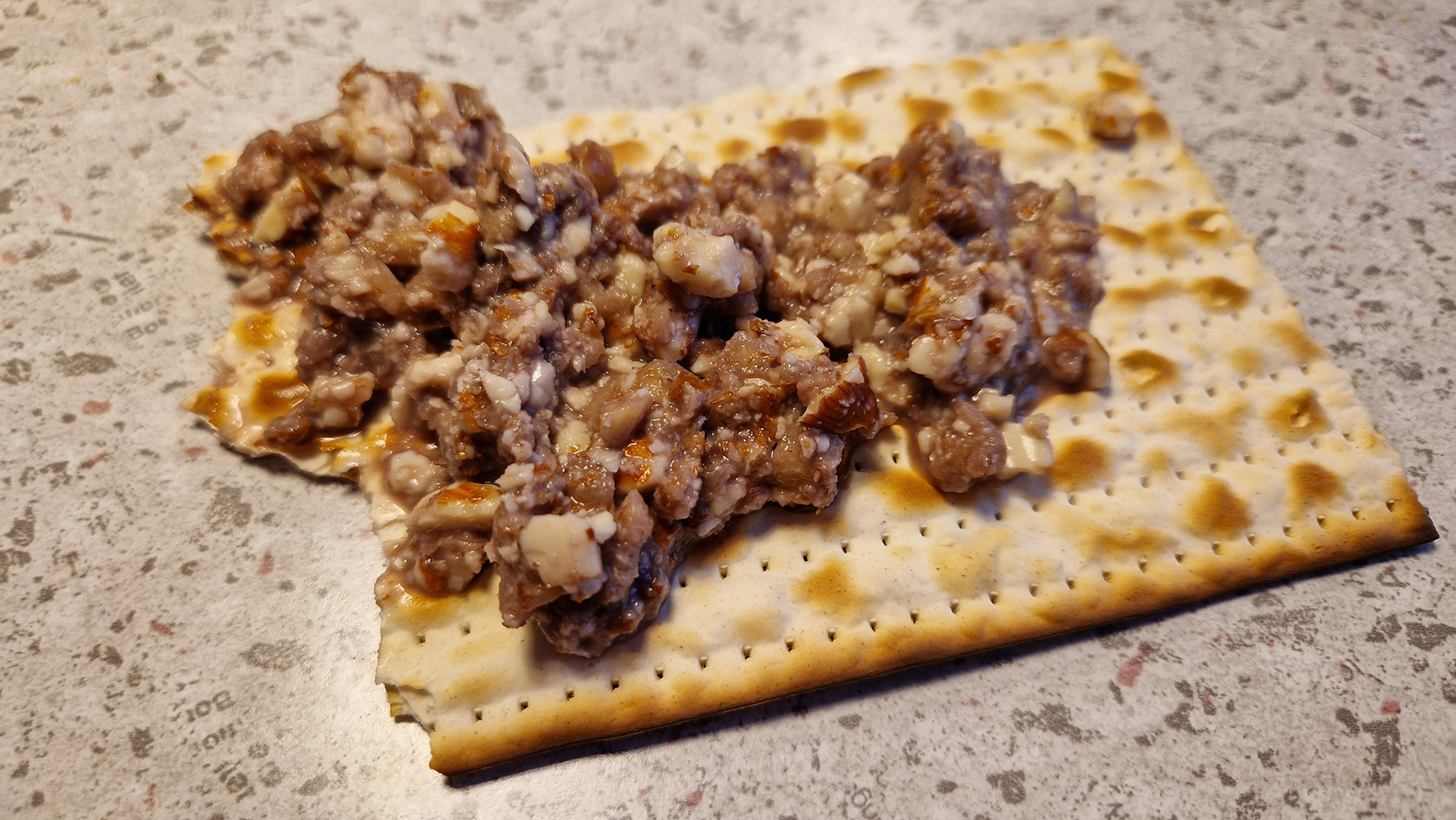
Matzah with charoses
On a Friday afternoon, together with my group of Jewish American Parents in Stockholm (J.A.P.S), I celebrated the Jewish holiday of Passover. We ended up starting over 2 hours late due to a major mix-up over who was to bring the tablecloths but this gave even the late-comers a chance to a long cacophonous schmooze with those who came on time, while 7 energetic small children ran around the room as though all 10 plagues were chasing them. After getting all the dinner food organized and putting out the seder plates, the covered matzahs, the candlesticks, the bowls with charoses, grated horseradish, and short stalks of parsley, the 24 adults and 7 children finally settled around the tables to start the seder.
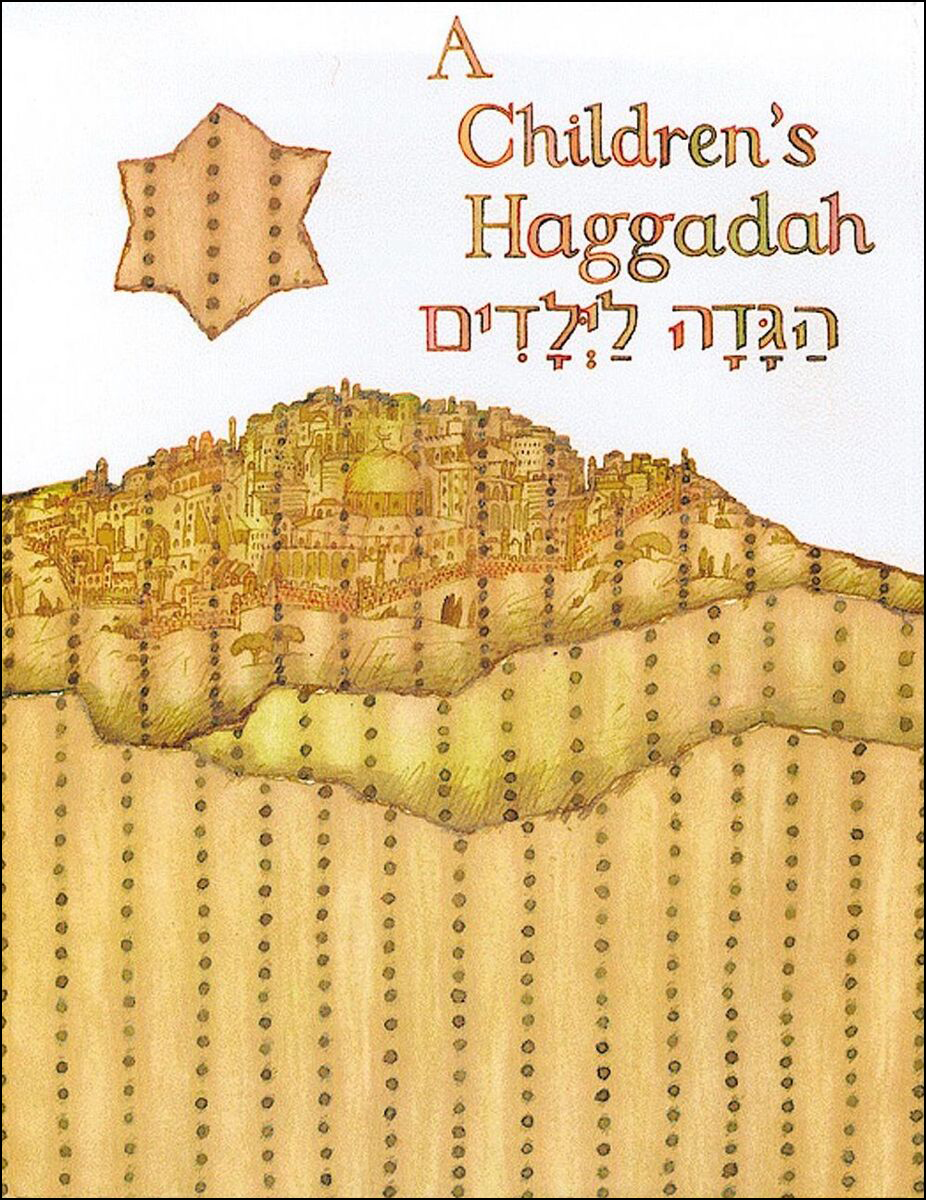
A Children’s Haggadah
The Haggadah we always use was something I found around 1996 in the Westside Judaica Shop on the Upper West Side of Manhattan. I told a salesperson there I was looking for a Haggadah – he lead me into a large back room filled to the ceiling with Haggadahs of every sort and kind. I was overwhelmed at first – how was I to find a Haggadah suitable for very secular families with children, amongst all this variety? The version I finally settled on was bought because it was filled with beautiful illustrations. (How a book looks is of course an important ingredient for a graphic designer) The Haggadah was titled A Children’s Haggadah, written by Howard Bogot and designed & illustrated by Devis Grebu. I bought 8 copies.
This Haggadah starts off with a page giving a short introduction about Passover, but as the leader of my crazy group I always like to start off the seder by first giving a short speech about the meaning of the holiday we are about to celebrate.
Here is what I said before we started to tell the story of the Exodus from Egypt.
First, I want to start off and say Welcome. It is so nice to see so many of our second-generation kids here and also many of our third generation too.
Originally, when first I sat down to try to write something to say today, I considered using the story of the all the horrible things that happen at Passover (like locusts, and red polluted water, unhealthy animals, slavery and death – just to name a few) and then relating all those bad things to what is happening in the world today.
I would first tell about what a hard year this has been personally for me due to having some aging friends who are now sick. I would move on to my own personal health worries and how I was trying to figure out what to do with what’s left of my own life.
And then I would correlate the plagues to a World level and talk about an uncalled for and totally arbitrary war in the Middle East threatening to spread World War three to the whole world. I was also going to mention all the horrible things that ICE and border patrol has been doing in America, destroying families, locking up children and killing US citizens in broad daylight. And not to mention the dictatorship the Orangeman in the White House is trying to install in my former homeland.
But…I didn’t want to be negative…so on second hand, I decided not to talk about all that terrible stuff at all. I am going to try to be positive instead.
In the fall of 1997 when I placed an ad in the American Women’s Club magazine, here in Stockholm, I said I was looking for other American Jewish mothers to gather together to do Jewish holidays with our kids. In 1998 and 1999 we met for Rosh Hashanah and I think, in 2000, we held our first Passover seder together all the way out in Vallentuna at Amy Brown’s place.
It’s been a long journey!
In that time, I have watched our little bubbelas grow up and start having their own little bubbelas. (For those who don’t know, Bubbela is Yiddish term of endearment meaning “sweetheart,” “darling,” or “honey, often spoken by old people (like myself) about youngsters.)
And now, having all of these bubbelas here today…makes me very happy.
Tonight, we are about to start our 26th J.A.P.S. Passover seder.
The Hebrew word, Seder, means order or procedure which is appropriate because when we hold a seder we always do it in a particular order. The Hebrew word, Haggadah, this book we are holding, means telling a story and our Haggadahs, contain the story that we will tell, in the correct order.
The Passover seder tells the story of how long ago, Moses led the Jewish people out of slavery in Egypt, to a life as a free people in Canaan.
When I was a lot younger, my family did the seder every year. I used to think it was the most boring holiday. All this blabber about what happened long ago. My family & my uncle’s family and my grandparents would all sit around the table taking turns reading meaningless texts out of the Haggadahs we used. All of us just waiting to get it over with so that we could finally eat the dinner waiting for us in the kitchen.
It wasn’t until I grew up…or maybe just grew older, that I learned that the Passover seder is so much more.
Pesach is the Hebrew name for this holiday and the word means to pass over something. And while this holiday can be seen as just a retelling of an historical event that we don’t really have any proof of actually happening, this whole process of the seder is so much more than just a history lesson. The Seder and the Pesach meal are full of themes and symbols that can still be relevant to our lives today.
So here is how the seder is still relevant.
As we tell the story of our ancestors, from long ago, becoming free, we are told to imagine ourselves being slaves and what it feels like for us today to be free, and to have compassion for others – for those who are poor, or who are gay or who are trans or are disabled and who do not yet have the freedom of being who they are or living the life they want to live. That is how it is still relevant.
Throughout the 8 days of Passover, we are expected to eat only Matzah, this crispy but boring mix of just flour and water, instead of eating cookies and cakes and fancy sour dough breads. But maybe by eating this very simple thing, it can help us to remember what is truly important in life – enough food to eat, a place to live, work we enjoy and good friends and family. All the trappings of wealth and materialism and power will not be what makes us happy. That is how it is still relevant.
Later in the service, the Haggadah has us asking 4 questions. And this asking of questions and looking for answers, illustrates the importance of actively using our minds to keep learning new things throughout our lives, always asking questions, even in today’s world. That is how it is still relevant.
Further on in the seder, we talk about the 4 types of children (it used to be the 4 sons but we are modern people and no longer gender specific). We mention the wise child, the wicked child, the simple child and finally the one who does not even know enough to ask. These different types of people can be found among all of us, the entire human race. And here in this Haggadah we are reminded to always have empathy and understanding for all types of people. That is how it is still relevant.
And then finally, we end the seder by singing the song Dayenu which in Hebrew means “it would have been enough” or “it would have sufficed”. We would have been happy with whatever we got. Singing this song at the end of the Seder reminds us and inspires us to be grateful for what we do have. That is how it is still relevant.
I am not real big on making Gratitude Lists but I want to end by saying that I am so grateful that so many of you could be here today. I am grateful that we have a place to meet, that we found enough chairs for all of us, that we have enough plates to set on the tables. I am grateful that so many made enough food for all of us to eat. And I am grateful that we can once again celebrate the Seder in peace and in freedom.
So let us start by lighting the holiday candles.