essays on life...by me

Tag: Life Page 18 of 22

My views on it.

Distance and points of contacts

How far away are you? How many miles to go? How long will it take? How many years has it been? Lets talk next Wednesday. When did you last meet? Should I measure in hours or years, centimeters or inches or just simply as the crow flies?

How do you determine distance? How do you measure it? What scale do you use: a tape measure, a yardstick, a minute, a year, a job, a dress, a party, a birth or a death?

When you think about distance it can mean so many different things. It can be the space between two points. Mark 2 dots on a piece of paper, then draw a line between them. Take out a ruler and measure the line. But is it 5 inches or 10 centimeters? How long did it take you to draw the line, 5 seconds or 5 minutes? You can say “She lives 100 miles away from me”. That is like the 2 points on the paper. But you can also say that your friend lives 2 hours away. Now the distance is about time. The scale is hours not miles, but its still about distance.

Twenty-three years ago I moved a relatively far distance away from New York City, the place that I had been wanting to live in since I was 10 years old. When I left New York City to move to Stockholm, Sweden, I crossed about 1,195 miles to get there. It took about 8 hours to do it and 6 years to decide. Before that, my only other move, had been when I left New Jersey and moved to New York, just a little over an hour’s drive time or about 50 miles. Both moves, whether it was a long journey to another country or just a short hop to a nearby state, meant leaving people I knew, behind. Hand-written letters or occasional, sometimes expensive telephone calls were the way to stay in touch at that time. Personal visits eventually got to be rare. A few of the people I moved away from continued with me through my life’s journey in spite of my moving away. Others became once a year Christmas cards till even they disappeared eventually. Distances were not easily crossed. The past stayed in the past. Memories of people I once knew became dimmer with time. But now, things have changed. And Facebook is the reason.

Unlike my younger 20-something friends whose huge lists consist mainly of people they know now, my list of Facebook friends tells a history of who I am and where I have been. It consists of people I know here in Sweden, as close as my neighbor in the apartment below me and as far as the outer suburbs of Stockholm or even other cities or towns. Also on the list are family members who have known me my whole life, friends gathered from each job Ive ever had, friends I shared time and talk with at Pratt, and friends from grammar school and high school. Some on the list, I talked to yesterday or met for dinner last weekend. Others I haven’t seen or spoken to in over 40 years.

With many of these friends, Facebook has become my main point of contact. Facebook has removed all concept of distance from all these points of contact. I know what people look like, who I never meet in person. Sometimes I feel like I know more about someone I haven’t seen in 40 years than I do about people here in Stockholm, in my life now. I know about the vacation plans of a friend who lives on the other side of the globe yet I don’t know what a friend I met for lunch last month will be doing. While listening to my friend across town complain about her teenage son sleeping long into the afternoon, I can tell her, “No, he’s awake. I just saw his status on Facebook that he wrote 25 minutes ago. He just hasn’t come downstairs yet.” I know more about my friend’s son than she does living in the same house.

And Facebook is so easy. I don’t have to put on my face or even get dressed in more than my bathrobe to socialize. I can make a joke about a friend’s cat or reminisce about childhood without setting foot outside my door. Even when I lived in New York City it was hard for my friends to get me to leave my apartment. Now in the days when the Yellow Pages have become obsolete, I can truly let my fingers do the walking. A few taps on the keyboard and I’ve shared a joke with someone a 7-hour plane ride away or across the street. For a lazy slug like me its just perfect.

And yet it feels very strange. I’m still not sure what to make of it. What is the etiquette for Facebook friends? If you start out as friends in real life then becoming Facebook friends is almost natural. But what if you get to know a person better through Facebook, can you then become friends in real life? Are you supposed to become real life friends? Do you invite Facebook friends to a party? Do you go to a Facebook friend’s party? When meeting in real life a FB friend, do you acknowledge the words, ideas, thoughts exchanged via FB or do you just pretend they weren’t written?

In a 1957 novel by Isaac Asimov, called The Naked Sun, he writes about a planet with a very sparse human population who live on huge estates, either alone or with their spouse only. Communicating with friends is done via holographic telepresence (called viewing, as opposed to in-person seeing). The viewing techniques are so well developed that you can take a walk or eat dinner with a friend who lives on the other side of the planet and not really notice that the wallpaper in their half of the room doesn’t match your own. There on Solaria, points of contact happen without needing any physical presence at all.

Is Facebook a little bit like that? A way to have points of contact over all sorts of different distances without the need to make the effort for any sort of real contact, person to person in the flesh?
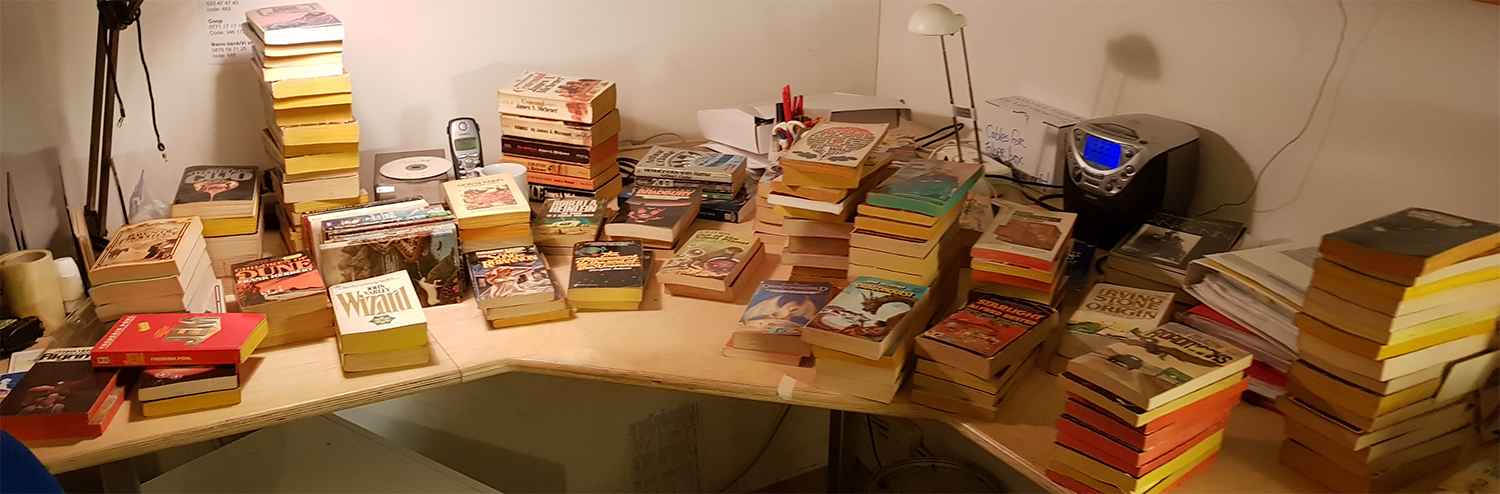
15 books that shaped me

Just some of the books that I have owned

My friend Caroline tagged me in Facebook with her list and I really liked the idea of making the same kind of list. Since the title of this list is “15 Books that Shaped Me” it seems to me that the majority of these books must be ones read early in life and which had a hand in forming the person one turned out to be. I’m no longer quite as formable as I was when I was much younger. But this doesn’t mean I no longer can find books that move me and make me see the world in a different way anymore. They just don’t have the same kind of world shattering effect they had when I was in my teens or 20s.

While how well a book utilizes language is important to me, I generally won’t be judging the quality and technical skill of the writing. But if the ideas or characters or events in the book are so able to move me, to make me think, to leave an indelible mark on me then so who cares if they know where to put their commas and semicolons. The important thing is that the words work.

Some authors write individual books with totally different stories in each, some write many books which inhabit the same universe. Once I enter the universe of an author that I like, I feel great sadness about leaving it and want to keep coming back. So its hard for me to stop at just one book. This makes it also hard to pick out just one book from that universe – I love them all. So some of this list will be more like a series from one author and some will be just individual books.

I had a hard time deciding how I would organize the books. By genre or by when read? I first decided to organize them in a vague timeline. But then I realized that, in reality, my reading generally falls into two categories: Science Fiction and everything else. So I’m going to put the Sci Fi first and then everything else after that. So let’s begin.

Here’s my list:

The Story of Peter and Wendy by James Barry (1911): By the time I was 10, Peter Pan and his Neverland had ceased being just another children’s book for me. They had reached mythical proportions. Peter’s Neverland was the place I tried to get to any time the real world became too hard. I always felt then and probably still do that Wendy was really dumb for wanting to grow up.

The Martian Chronicles by Ray Bradbury (1950): I read this book when I was 11. It was one of my father’s collection of Science Fiction paperbacks. While I understood that it was a chapter book, I was very confused by the fact that each chapter while always about Mars, didnt just follow the previous chapter events. Ray Bradbury himself called it, “a book of stories pretending to be a novel”. Each chapter had different characters and the events took place in unrelated time and space. I had never read a book like that before. The story of the Martian, Tom, a shape-shifter able to take-on the appearance of someone known to the person looking at him has remained with me to this day. While in the town, everyone “Tom” passes sees a person of their own. The Martian, exhausted from his constant shape-changing, spasms and dies. When I read this story I realized you have to be who you are for own self, not try to shift your shape to fit what other people want to see. An idea I still believe to this day.

The Foundation Trilogy by Isaac Asimov (1951, 1952, 1953): I read these sometime in the early sixties when they came, all together in one volume, as a freebee when someone, I don’t remember if it was my dad or brother, joined the Science Fiction Book club. I loved the century spanning scope of it and the way it described individual independence versus the inevitable actions of the masses. I went on to read most of Asimov’s books and in a “Man and His Gods” course in college wrote a very long essay on Asimov’s cosmology using about 10 of his novels. Got a B in the course.

The Lord of the Rings by J.R.R. Tolkien (1954–55): What can one say about LOTR? It is the unparalleled, ultimate Fantasy novel by which every other Fantasy novel is judged. Professor Tolkien didn’t just write a story. He spent his entire life building a world and it shows in every word he put on paper.

Cyteen (1988) and the Chanur novels (published between 1981 and 1992) by CJ Cherryh: Like Isaac Asimov, CJ Cherryh sets many of her novels in the same universe. Cyteen takes place in her Alliance-Union universe, the part of Space known to space-faring humans. Chanur takes place in the same universe but in a region of space in the opposite direction from Earth as the Alliance and Union. The Chanur region is populated by 6 totally alien races mainly unknown to the humans who have traveled out to the other side of Earth. The 6 species trade together under a series of trade agreements called the Compact. (some of the Cyteen and Chanur text is taken from Wikipedia. They do a much better job at summerizing than I ever could. So why reinvent the wheel)
Cyteen is a story about the attempt to clone a brilliant woman scientist who is killed prematurely. Because her own parents, who were also scientists, documented every moment of her childhood, those who wanted to recreate the same person thought if they did everything the same way to the clone they would get the same person. They didn’t get what they expected. A wonderful exploration of human nature set on a different world, in a future time, but still peopled by human beings.
The Pride of Chanur is the first in a series of 5 books. A human exploration ship is captured by one of the more unpleasant alien species. The last human surviver, Tully, manages to find safe harbour aboard the merchant ship belonging to a Hani named Pyanfar Chanur. The entire story is told from the viewpoint of the sleek pelted Hani as they try to understand the strange, bare skined human with a head of golden hair. The realistic handling of linguistic and psychological barriers is one of the stronger aspects of the books. Coercion, manipulation, politics, pride contests, and clashing economic interests as well as species-to-species miscommunication and misunderstanding are just some of the things that make these books so fascinating. Just as Jonathan Swift’s Liliputians were really a commentary on the people of his own time so are all the aliens in Compact space simply human with a twist.

Neuromancer by William Gibson (1984): Fabulous sensory overload about a not so distant future Earth I hope I never have to live in. I’ve also read all his other books.

The Hitchhikers Guide to the Galaxy by Douglas Adams (between 1979 and 1992): Starting off with Don’t panic, this series of books are a wonderfully funny, sarcastic and inventive examination of the nature of humankind. My favorite was Adams’ description of the “Somebody-else’s-problem invisibility shield”. This is a force that operates frequently in my home, especially when applied to dirty laundry on the floor.

Gone with the Wind by Margaret Mitchell (1936): I read this book when I was 16. I loved this book! And the movie was equally great. For many years this book was a bell weather showing how I was feeling about relationships – If I felt the book hinted that Scarlett would win back Rhett, things were good. If things were bad, I was certain she had blown it for good.

Atlas Shrugged by Ayn Rand (1957): When I was 20 years old, Ayn Rand explained the way the world works to me in this book. I recently found my paperback copy from way back then and had the chance to read all the notes I had made in the margins. I’m still looking for John Galt; and Dagny Taggert was one of the first really strong, independent, smart, female roll models I was to run across and look up to.

Doris Lessing: The Golden Notebook, The Martha Quest series, the entire Canopus in Argus series, and the one that had the biggest life/decision effect on me – The Grass is Singing. The moral of the story in the Grass is Singing – never mistake for good, something you know in your heart is wrong for you.

The Prince of Tides by Pat Conroy (1986): I loved the way this novel drew me into it as Conroy bit by bit brings the reader to the explosive core. A wonderful story about the human heart and soul. And the words used to tell it just dissolved in my mouth, melting around my tongue. Just plain wonderful writing.

The Poisonwood Bible by Barbara Kingsolver (1998). An amazing mad journey to the depths of Africa. Bringing Betty Crocker cake mixes.

The Lovely Bones by Alice Sebold (2002). When the book club that I was member of for a short time recommended this book to me by saying it was about the rape and murder of a young teenage girl, I said, “No way, I cant read that”. But I did and could. It describes a type of Heaven that I can live with.

Well, that’s the short list. As usual, I can’t just say a few words when many will do.

Off the board

Today was my last day on the board. While a bit relieved I also feel a bit sad about it. Board?? What board you ask. Diving board? Ironing board?

About 5 years ago I started getting involved in a number of Swedish organizations. And by that I mean organizations where I was probably the only Native English Speaker in the group. My kid was growing up, a staff job had begun to replace the freelance life (which, anyone who ever had a freelance life knows, makes it hard to plan anything in advance), my family didn’t need me as much as before, I had finally begun to feel confident in speaking Swedish and I had completely stopped blow drying my hair. I felt like I had some extra time on my hands.

The first organization I joined was a group called Progressiv Judendom i Sverige (PJS). It was a non-profit association formed to bring Reform Judaism to the Jewish Community of Stockholm. As a long time member of Stockholm’s Jewish community, I had spent many years complaining about the very conservative, almost Orthodox and extremely lifeless and meaningless type of services conducted in the Great Synagogue here. When I heard that a group was forming with the intent to start holding a more liberal and different type of service, I realized that I had to put my money where my mouth was and join. When I saw that the contact person had the same telephone exchange as I did I realized that she must live right near me and it was just fated for me to be a member. I’ve been on the board ever since. I do the website. But I’m a very bad webmaster – always late updating. But we have very pleasant monthly board meetings across the park from my place in Eva-Britt’s apartment, where we eat home made soup and chat before starting our meetings.

The next group I joined was sort of an offshoot of the first. It is the infokommittén of the Jewish Community. I got volunteered for it by a fellow PJS board member but don’t regret joining. Its a loosely organized group of people working in the advertising and media branch and the main thing we have in common is that we are Jewish. We gather at the Jewish Center every 5 or 6 weeks to discuss how to keep the Jewish community here alive. In other words how to increase the number of paying members. There is a wide range of Jewishness in the group, from Orthodox to secular to cultural, with an interesting mix of personal stories and like with most European Jews a wide range of different national experiences. Everyone is very professional and whatever differences we have regarding how we practice our own brand of Jewishness never seems to get in the way. Its interesting and I get to hear about all the inside workings of the community.

Finally, the last group I joined is the one that I no longer am a member of. For almost 2 and a half years now Ive been on the board of the Thorildsplan gymnasiums föräldraförening. I guess you could call it the PTA of my son’s high school. Once again, I was on the board of a brand new organization. The woman who has been the chair and guiding force is named Ann. And it just accidentally turned out that she was the mother of one of Bevin’s three best friends in his class. Once again fate steps in. That we have our sons in common was just another reason to join. I have always been very involved in my son’s schooling, ever since I enrolled him in a parent cooperative daycare. In lower school (1-3 grades) I probably went on every day trip as a class parent that his class took. In middle school I was a class parent every year and helped plan his sixth grade class trip to Åland. I also went along as a class parent on that trip too. And in 9th grade, his final year of grammar school, I once again helped to organize their final 2 day trip, going along as class parent one more time and I ended the year as a chaperon at his school prom.

But by the time a kid reaches gymnasium (high school) it seems that most Swedish parents are no longer interested in their kid’s schooling. Very few gymnasiums have PTAs. But Ann was determined to start one at Torildsplan gymnasium. And I joined her in her quest. Together with a few other board members we would meet about 8 times during the school year in the school’s teacher’s lounge to drink our coffee and discuss how to get parents in the almost 1000 student school interested in being a member. At Open House we gave out flyers, telling them about our organization. It was an uphill battle. Parents just didn’t seem interested. Tonight was the General Annual meeting for the new school term. 5 or 6 new parents came to the meeting. Which was good, since this past spring my son graduated from Torildsplan and is now in college. Some of the new parents were willing to join the new board. Ann, whose son graduated alongside mine this spring, was still willing to take on the responsibility of being the Chair. I, however, felt my time on the board was over. I feel that its time to move on to something new. But even as I left the cafeteria and walked along the corridors headed for the door while the new board members held their first meeting, I felt sad. It was an ending and I think endings are always sad. When my son graduated this spring, it was also an ending. But up ahead, just around the corner, he had a whole new school life waiting for him to begin, in college.

I’m still on the board of PJS, I still will be going to meetings of the infokommité, but my time on the föräldraförening has ended. I wonder what is waiting for me – what is it that is just around the corner.

The Good Wife = Perfect Television

Perfect

Perfect

I just finished watching The Good Wife on TV tonight. Its the only story-arc series I’m bothering to keep track of at the moment. Television series that have a story-arc are more difficult to get attached to. It means you have to allocate the time to make sure you watch it every week. If you miss an episode its like skipping a whole chapter occasionally while reading a book. I like this show enough to make the effort. I’m not really a detective/murder/police/lawyer genre person. I usually read Sci Fi for my escapist entertainment. My problem with crime/lawyer etc stories is that even after they tell me who did it I still don’t understand how it got done. Or if its in book form I frequently want to read the ending after the first few chapters. It helps me to figure out if I want to spend the time finishing the book. But it doesn’t really give away the plot. Even if you read the ending you still don’t know HOW A got to Z. But, it peaks my curiosity to read the end.

Anyway, back to The Good Wife. I like the main character, the wife. I remember the actress from ER. Boy does she look different now! She has really curly hair like me but now its so sleek, I’m jealous. Alicia, the wife is perfect. Smart and rarely a hair out of place. Perfect eyebrows. Perfect clothes, classic, always matching, sober colors, that fit her perfectly and look great. She is always collected and in control all the time. Knows what to say and even if she is taken by surprise rarely ever gives away anything she is thinking. Of course its easy for her – she has a crew of hairdressers and stylists at hand to make sure she stays looking that way and a script to tell her what to say. But I’ve run across women like that in my life. I can’t say that I ever became good friends with one though. Mainly because they intimidate the shit out of me. They are the kind of person I used to wish I could be but know that I never will be.

BK (before kid) I used to Dress. I liked clothes. They were my mask. I used to sew my clothes and I did it well. My costume fit me perfectly. I wore makeup (still do that) and spent a lot of time on trying to force my hair into doing what I wanted it to do. (gave up on that) But even though I easily admit to being a control freak, I was never an over-achiever. Even in school. If I got an A easily, I was happy with that. If I got a B and would have had to work hard to make it into an A, well I was happy enough with the B.

Actually there are two kinds of perfect. The first type is the kind of perfect that an over-achiever has had to work really hard to achieve and which somehow, nevertheless, always seems a bit forced and false. Then there’s the second kind – the perfect kind of perfect. That kind of perfect never seems false or even over-worked; it just seems perfectly natural. It has to do with Style, with a capital S. Grace Kelly had that. So did Katherine Hepburn. And so does Alicia.

Actually, I like Alicia, the good wife, because she is everything I am not. Even when I used to DRESS there was always something that kept it from being perfect. I definitely wasn’t classic style to begin with. I once had an outfit of black slacks with big yellow polka-dots, paired together with a yellow blouse with tiny black polka dots. I wore them with a black belt and a pair of black earrings that had small yellow and white polka-dots on them. So what wasn’t perfect, one might ask? Well in my mind, the yellow blouse wasn’t exactly the same shade of yellow as the yellow polka-dots on the pants. Close but not perfect. For a control-freak that’s important. But not being an over-achiever, it was good enough for me. I realized that I was never going to be the second kind of perfect. The kind that just comes naturally.

Good enough

Good enough

Because its not just about the clothes. Its the good wife’s whole manner. She’s so serious, on the outside at least. But not me. I’m serious on the inside, but not on the outside. Making a joke and being silly is more my style. I don’t mull over every word before I say it. I just blurt it out. I’m not so sure if that’s good or bad but I don’t really care any more. The only thing I want to be taken seriously for is the work I do. That’s important. And that the people that I care about know that I care about them. That’s also important. But I’ve pretty much given up trying to be any kind of perfect. Good enough is good enough for me. I can enjoy watching perfect people on TV and that’s just perfect.

Page 18 of 22

Powered by WordPress & Theme by Anders Norén