essays on life...by me

Category: Autobiographical Page 4 of 5

The relay race

My mother was recently in the hospital. She’s back home now, but not really home, not in her own apartment but in the rehabilitation health-care center of the independent-living facility that she has been living in for the past two years or so. It seems she had a pelvic fracture and had trouble standing up or walking. So she is there for them to look after her and give her physical therapy to help her heal. When they are not busy torturing her with exercise she spends most of her time in bed watching the television. I call her most every day and talk to her, ask her how she is doing, telling her about small things happening here in my home. Its really all I can do, living so far away. She sounds tired as I talk to her. She still manages to be cheerful but often she sounds tired. Anyone who has had to spend more than a few days in bed just watching TV knows how tiring that gets to be after awhile. You start wanting to be able to leave the bed and get on with your life. Start doing things again. But doing things has been getting harder and harder for her to do.

Talking to my mom makes me think of my grandmother. Not that my mom is anything like Grandma, she is definitely much nicer than my grandmother ever was. But the tired thing. It reminds me.

I remember a day, standing in front of the large bathroom mirror in my parents house with Grandma, looking at our reflections. We were dressed up for some holiday family get together. Grandma is in her 80s. She looks at herself and says she doesn’t recognize the person she sees there. She doesn’t feel as old as that person looks. She talks about how she used to be as strong as an ox but not anymore. I didn’t really understand what she meant then. After all, I was barely 30, strong and healthy, still.

I recognize my grandmother in the black and white photographs that I have from her. I see her in my mind’s eye in the story she told of herself, newly arrived and processed at Ellis Island after her 2 week-long journey from Poland in 1920. She was 20 years old then, just a few months older than my son is now. She sees her brother Nathan, standing there in the large hall, tall and well dressed, waiting for her. She runs into his arms, knocking off his bowler hat in the process. Her life is just starting. She has almost a decade of good years after that, and then the Depression starts. Her married life during the 1930’s, her thirties, bring with it all the years of economic hardship, but she struggled through it. Followed closely by the 1940s and the discovery that almost all of her family left behind in Poland were gone. In 1948, she and Grandpa made a nice wedding for their daughter and saw Evelyn start her life as an adult with my dad.

I didn’t know Grandma then. I was born when she was already in her 50s and probably younger than I am now. I can remember her loudly arguing in Yiddish with Grandpa in their kitchen in their house in Budd Lake. I was over their house when I was a kid, playing in the backyard. I saw a snake crawling through the grass. I ran into the house screaming, afraid of the snake. My grandmother ran out, grabbed a hoe and killed the snake. I thought she was the strongest and bravest person I had ever met. I must have been about 8 or 9 years old.

I think of my mom. I turn over in my mind, memories of her, mind photos you could call them. I think of her when she was a young woman and I was just a kid, in her 30s and 40s, active, working, volunteering, raising children. Competent, taking care of things. Getting on with her life. I knew her then but didn’t give her much thought. She was my mother. I took her for granted. When I was 18, my father and mother drove me off to Brooklyn with all my transportable belongings and delivered me to the dormitory at Pratt – starting me on my journey towards adulthood. They continued on their trip back home to Budd Lake to live their life, to retire, to move to a new home in Columbus, New Jersey, taking with them boxes of my stuff I had left with them in Budd Lake.

I’ve known four generations of my family now – Grandma Bertha, my mom Evelyn, myself of course and now my son. I’ve seen these generations as they go by. I’m 10 years older now than my grandmother was when I was born. I’m almost the same age as my mom was when I moved to Sweden. I’m at the age I am now as my son is starting his first tentative steps into adult life. Our generations overlap. They are like a part of a revolving relay race through time. Each generation handing on the baton to the next. A real relay race has an actual begininning, at the sound of the starter’s pistol. But this generational relay race has no real beginning – before my grandmother started, there were her parents and before them more parents; and hopefully, it has no end, though sometimes it does when the next generation isnt born. But my personal race has a beginning. It started with the oldest family member that I actually got to know – my grandmother and is continuing with my son. That is my snippet of the eternal ever-revolving relay.3 generations, my mom, me and my grandmotherIn my snippet, my grandmother stands at the starting line, waiting for the sound of the gun. Off she goes, running as fast and as strongly as she can. Sometimes the path is straight and easy, sometimes it’s curving and difficult but she keeps on going. There ahead of her she sees the next member of her team. That’s my mom – there, jogging along the track in the hand-off zone. They run together for awhile, both running strong, working together. And there it is – the hand-off! Now its Mom who has the baton. She’s in the field now, running her own race. Grandma of course doesn’t stop running immediately after the hand-off. She keeps on going, slowing down gently, but still running along. Now Moms coming around the bend. I enter the track, start jogging in the hand-off zone. We both run together until finally, the time is right and Mom hands me the baton. I’m off! Running my race through Art School in Brooklyn, then life in New York City, then the big curve – moving to Stockholm. I’m now approaching the next hand-off zone. I see him there entering the field, my son Bevin. He’s starting to jog while I come up along side him. We run together a good pace while he comes up to speed. Soon, very soon, I will hand him the baton and he will be off on his own race as I wind down, slowing my pace, preparing myself to stand on the sidelines cheering him on, as my Mom is now doing for me.

This race of ours is a good one, as we all make it around our track in our individual legs of our journey. I hope my son gets to run a good race on his leg of the track and as he runs, remembers the runners he has met that have helped to hand him the baton.
Choices

“You shouldn’t feel guilty for not being there to help her. You shouldn’t feel guilty that she is ill and elderly and alone, without family near her or many friends nearby. She made her choices and you do what you are able to do, when you can do it, to help her as much as you can. She’s where she is because of the choices she made.” This is what a friend told me recently.

But what kind of choices do we make in our lives? How much thought do we give them? How free to choose are we? And how responsible are we for our own choices and the choices of those near and dear? And even those far away?

I go into the supermarket to buy food for dinner. If I’m just coming home from working hard all day at my job and its getting late and I’m tired, Ill be looking for something quick and easy to make. Perhaps I buy a package of Bratwurst, enough for all of us and a box of instant mashed rutabaga. The bratwurst just goes in under the broiler for 10/20 minutes and the powered rutabaga only needs to be poured into boiling water and stirred and allowed to sit for 5 minutes. Voila! A tasty meal in under a half hour. Add some sliced raw carrots and you are all done.

But if I know that Ill be home most of the day and can spend some time and energy on making dinner then I will buy a different sort of ingredients. Perhaps I want to spend the time making a stew or even a roast. Maybe with a creamy potato casserole to go alongside the roast. For those kinds of meals I buy different ingredients. For the stew, I need to get enough stewing meat, a lot of nice potatoes, a bag of carrots, some onions, preferably the red kind, and maybe even mushrooms. For the roast and casserole I need to find a nice chunk of beef, a bag of potatoes, onions, cream, and a nice cheese to grate into the casserole. Ill also pick up veggies to include in a good salad and maybe even stop off at the local bakery to pick up a nice crusty fresh baked bread.

But for all three of these meals, the fast food and the slow food, I’m required to make choices. For the slow food dinners I might use a cookbook to guide me. It will tell me how long the roast should be in the oven and what temperature for it to come out good. For the fast food, I might read the ingredients on the package of the bratwurst and decide which brand of bratwurst based on what it says on the package. The box of rutabaga will give me instructions on the side of the box and might even give me ideas how to improve it.

But where’s the instructions for life? Where’s the cookbook that tells us what to do, in what order so that when we’ve cooked our life we haven’t burned the meal and ended up hungry?

When I moved to Sweden 23 years ago, both my parents were still alive, still living in the house I grew up in and still working. I admit I didn’t give them much thought when I decided to move so far away. I was more concerned about leaving my friends behind. Now things are different. My dad is gone since 1997 and my mom has moved twice since I moved to Sweden. The 10 years she and my dad had at the 55+ place called Homestead were good years for them and the 10 years there after my dad died were also pretty good. She had lots of friends and activities to keep her busy and I would come to visit once a year, usually dragging my family with me. Two years or so ago, she graduated from Homestead’s 55+ to Independent Living at Monroe Village. There she started off her stay by editing the Resident’s Newsletter, following a life-long love of writing, and she met Marty. Life was good and still independent was a key idea. But last week she ended up in the hospital because she had trouble walking. Now she is spending some time in Monroe Village’s health care center where they can keep a close eye on her and give her physical therapy to get her legs working again. I try to call her everyday. But life in the health care center is pretty boring. While she still sounds cheerful when I talk to her, she also sounds tired. Like life is getting too complicated, with all the medicines, and doctors and feeling in pain and not being able to walk or be in her own apartment. And I feel guilty that I’m not there to be of help to her. And here we come back to the choices we make in life.

I don’t mean only my choice to move to Sweden but also my mother’s choice to live where she lives. She chose long ago to live in Budd Lake NJ. That was pretty far from much of her family which were centered closer to New York. But it wasn’t really her own choice. It was made more by her parents who had bought a summer cottage there and eventually both my parents and grandparents decided to permanently move there – away from the rest of the family. Then when my grandmother died, my folks found Homestead and moved there, even further away from New York. But they loved living there so it was a good choice and an independent choice. Now she lives where she lives. Still independent.

And I feel guilty that I am so far away.

15 books that shaped me

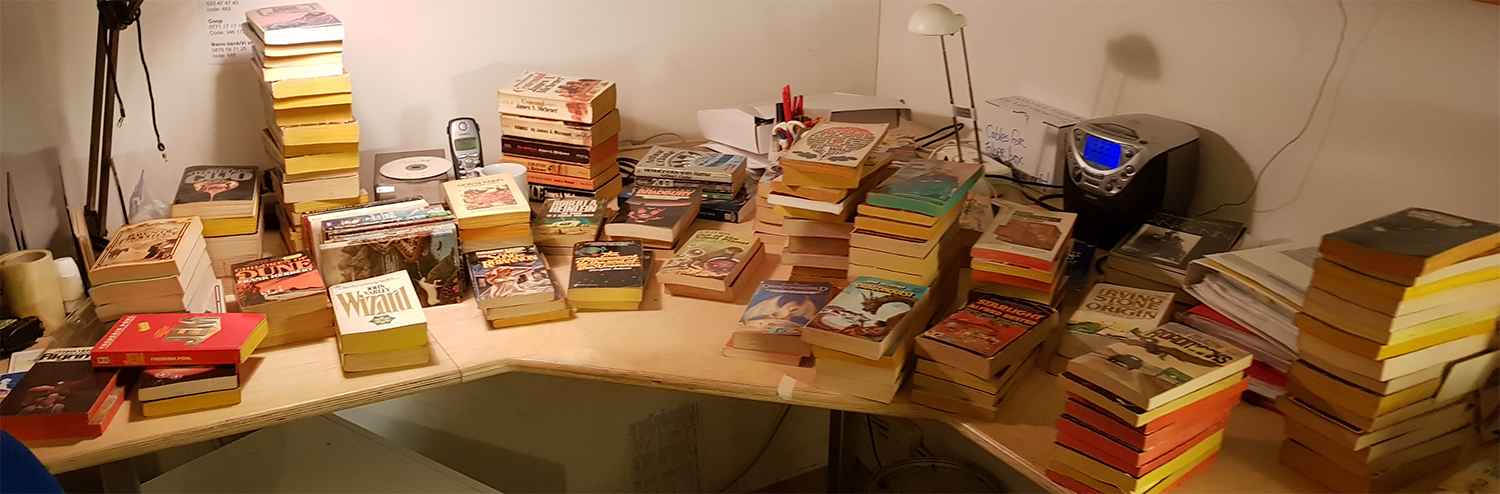
Just some of the books that I have owned

My friend Caroline tagged me in Facebook with her list and I really liked the idea of making the same kind of list. Since the title of this list is “15 Books that Shaped Me” it seems to me that the majority of these books must be ones read early in life and which had a hand in forming the person one turned out to be. I’m no longer quite as formable as I was when I was much younger. But this doesn’t mean I no longer can find books that move me and make me see the world in a different way anymore. They just don’t have the same kind of world shattering effect they had when I was in my teens or 20s.

While how well a book utilizes language is important to me, I generally won’t be judging the quality and technical skill of the writing. But if the ideas or characters or events in the book are so able to move me, to make me think, to leave an indelible mark on me then so who cares if they know where to put their commas and semicolons. The important thing is that the words work.

Some authors write individual books with totally different stories in each, some write many books which inhabit the same universe. Once I enter the universe of an author that I like, I feel great sadness about leaving it and want to keep coming back. So its hard for me to stop at just one book. This makes it also hard to pick out just one book from that universe – I love them all. So some of this list will be more like a series from one author and some will be just individual books.

I had a hard time deciding how I would organize the books. By genre or by when read? I first decided to organize them in a vague timeline. But then I realized that, in reality, my reading generally falls into two categories: Science Fiction and everything else. So I’m going to put the Sci Fi first and then everything else after that. So let’s begin.

Here’s my list:

The Story of Peter and Wendy by James Barry (1911): By the time I was 10, Peter Pan and his Neverland had ceased being just another children’s book for me. They had reached mythical proportions. Peter’s Neverland was the place I tried to get to any time the real world became too hard. I always felt then and probably still do that Wendy was really dumb for wanting to grow up.

The Martian Chronicles by Ray Bradbury (1950): I read this book when I was 11. It was one of my father’s collection of Science Fiction paperbacks. While I understood that it was a chapter book, I was very confused by the fact that each chapter while always about Mars, didnt just follow the previous chapter events. Ray Bradbury himself called it, “a book of stories pretending to be a novel”. Each chapter had different characters and the events took place in unrelated time and space. I had never read a book like that before. The story of the Martian, Tom, a shape-shifter able to take-on the appearance of someone known to the person looking at him has remained with me to this day. While in the town, everyone “Tom” passes sees a person of their own. The Martian, exhausted from his constant shape-changing, spasms and dies. When I read this story I realized you have to be who you are for own self, not try to shift your shape to fit what other people want to see. An idea I still believe to this day.

The Foundation Trilogy by Isaac Asimov (1951, 1952, 1953): I read these sometime in the early sixties when they came, all together in one volume, as a freebee when someone, I don’t remember if it was my dad or brother, joined the Science Fiction Book club. I loved the century spanning scope of it and the way it described individual independence versus the inevitable actions of the masses. I went on to read most of Asimov’s books and in a “Man and His Gods” course in college wrote a very long essay on Asimov’s cosmology using about 10 of his novels. Got a B in the course.

The Lord of the Rings by J.R.R. Tolkien (1954–55): What can one say about LOTR? It is the unparalleled, ultimate Fantasy novel by which every other Fantasy novel is judged. Professor Tolkien didn’t just write a story. He spent his entire life building a world and it shows in every word he put on paper.

Cyteen (1988) and the Chanur novels (published between 1981 and 1992) by CJ Cherryh: Like Isaac Asimov, CJ Cherryh sets many of her novels in the same universe. Cyteen takes place in her Alliance-Union universe, the part of Space known to space-faring humans. Chanur takes place in the same universe but in a region of space in the opposite direction from Earth as the Alliance and Union. The Chanur region is populated by 6 totally alien races mainly unknown to the humans who have traveled out to the other side of Earth. The 6 species trade together under a series of trade agreements called the Compact. (some of the Cyteen and Chanur text is taken from Wikipedia. They do a much better job at summerizing than I ever could. So why reinvent the wheel)
Cyteen is a story about the attempt to clone a brilliant woman scientist who is killed prematurely. Because her own parents, who were also scientists, documented every moment of her childhood, those who wanted to recreate the same person thought if they did everything the same way to the clone they would get the same person. They didn’t get what they expected. A wonderful exploration of human nature set on a different world, in a future time, but still peopled by human beings.
The Pride of Chanur is the first in a series of 5 books. A human exploration ship is captured by one of the more unpleasant alien species. The last human surviver, Tully, manages to find safe harbour aboard the merchant ship belonging to a Hani named Pyanfar Chanur. The entire story is told from the viewpoint of the sleek pelted Hani as they try to understand the strange, bare skined human with a head of golden hair. The realistic handling of linguistic and psychological barriers is one of the stronger aspects of the books. Coercion, manipulation, politics, pride contests, and clashing economic interests as well as species-to-species miscommunication and misunderstanding are just some of the things that make these books so fascinating. Just as Jonathan Swift’s Liliputians were really a commentary on the people of his own time so are all the aliens in Compact space simply human with a twist.

Neuromancer by William Gibson (1984): Fabulous sensory overload about a not so distant future Earth I hope I never have to live in. I’ve also read all his other books.

The Hitchhikers Guide to the Galaxy by Douglas Adams (between 1979 and 1992): Starting off with Don’t panic, this series of books are a wonderfully funny, sarcastic and inventive examination of the nature of humankind. My favorite was Adams’ description of the “Somebody-else’s-problem invisibility shield”. This is a force that operates frequently in my home, especially when applied to dirty laundry on the floor.

Gone with the Wind by Margaret Mitchell (1936): I read this book when I was 16. I loved this book! And the movie was equally great. For many years this book was a bell weather showing how I was feeling about relationships – If I felt the book hinted that Scarlett would win back Rhett, things were good. If things were bad, I was certain she had blown it for good.

Atlas Shrugged by Ayn Rand (1957): When I was 20 years old, Ayn Rand explained the way the world works to me in this book. I recently found my paperback copy from way back then and had the chance to read all the notes I had made in the margins. I’m still looking for John Galt; and Dagny Taggert was one of the first really strong, independent, smart, female roll models I was to run across and look up to.

Doris Lessing: The Golden Notebook, The Martha Quest series, the entire Canopus in Argus series, and the one that had the biggest life/decision effect on me – The Grass is Singing. The moral of the story in the Grass is Singing – never mistake for good, something you know in your heart is wrong for you.

The Prince of Tides by Pat Conroy (1986): I loved the way this novel drew me into it as Conroy bit by bit brings the reader to the explosive core. A wonderful story about the human heart and soul. And the words used to tell it just dissolved in my mouth, melting around my tongue. Just plain wonderful writing.

The Poisonwood Bible by Barbara Kingsolver (1998). An amazing mad journey to the depths of Africa. Bringing Betty Crocker cake mixes.

The Lovely Bones by Alice Sebold (2002). When the book club that I was member of for a short time recommended this book to me by saying it was about the rape and murder of a young teenage girl, I said, “No way, I cant read that”. But I did and could. It describes a type of Heaven that I can live with.

Well, that’s the short list. As usual, I can’t just say a few words when many will do.

Senses

I see the world though only my eyes.
I hear the world through only my ears.
I taste the world through only my tongue.
I touch the world through only my body.
I smell the world through only my nose.
I feel the world through only my heart.
I understand the world through only my mind.

These are the only things we can truly know. Anything else that doesn’t come through our own senses and perceptions are just hearsay and second hand. But all around us in the world we are continually being influenced by what other people see, what other people hear, what other people think.

Page 4 of 5

Powered by WordPress & Theme by Anders Norén