essays on life...by me

Category: Relationships Page 2 of 3

The stories we tell

I recently spoke with a very dear friend who I have known a very long time on a one and a half hour skype call. We spent a lot of time talking about family and discussing our past. She told me some things about her parents I hadn’t heard before and I told some of the stories from my family. And this got me thinking about the stories that are passed down from our parents and grandparents. The way we tell them. The way we tell them as if they were true. I told her that the story as she heard it from her father might not have been the way it really happened. And she answered me by saying that that was the way it happened – her father wasn’t a liar, he told her the truth. I told her that I wasn’t calling him a liar but that his story of what happened in his life was just the way he remembered it. But it didn’t mean that that was actually what happened. He wasn’t a liar – he was human. Like the story from my grandfather about the boat he took in his travel from Poland to the USA in the early 20th century. When my cousin researched his history, she couldn’t find him on that boat. But another boat was in New York Harbor at exactly the same time and on that boat’s list was his name. He had seen that other boat when he arrived in America and instead of remembering the name of the boat he was on, he remembered the name on the side of the ship he saw when entering the harbor to his new world. He wasn’t a liar – he was human.

Humans tell stories. Well some of us do. Not all. Some are just silent, unable to make sense of the life they are living, unable to recreate it in words, unable to examine what their life is. But I think most of us humans tell stories. We have a need to explain and understand ourselves. Did a person not choose to go down a path in their lives because they felt it was better to stay at home or was it because they were afraid. Did a person become successful because their own father encouraged and supported their choices or were they just lucky? Did someone not follow their dream because they just didn’t want it bad enough or because they weren’t strong enough to buck a domineering mother?

Life is never a straight shining path. It is a crooked, winding, bumpy road with all kinds of divergent paths leading off to different directions. What fork you choose to take at any of those branches determines the path of your life – you rarely get a chance to backtrack and redo your choice. You can only move forward. But your mind can redo those turns you took.  You can think back and tell yourself “I took that path because your father was there and I chose to marry him”. But years later, well along on the chosen path, deep down, you know that the reason you didn’t follow the path of your dream was because you weren’t brave enough to do so, and so, you took the easier path.  And yes in many cases, having encouraging parents or advisors who can help you decide what is the best choice for you to follow is definitely an asset. Many of those forks in the road get walked without any forthought whatsoever. We humans just go where our feet lead us and then spend decades mulling it over and telling the story which we, with our human memories, remember about it. And that is the life story that our children or our friends get to hear and to pass on to others.

I think I must have been born a sceptic (or at least someone who was unwilling to accept at face value what others told them). Maybe not since birth but definitely since I was four years old. I was four years old when I needed to have my tonsils removed. The very nice doctor told me it wouldn’t hurt and afterwards, I could eat all the ice cream I wanted. When I woke up my throat hurt a lot and when I tried to eat the ice cream my mother gave me, it hurt even more. That very nice doctor lied to me!! And I don’t think I ever believed anyone else, or the stories they tell, wholeheartedly, ever since.

I know people who never fail to say how much they loved their parents or how much they respected them, or admired them, or looked up to them or miss them greatly once gone. And I have to admit, this makes me feel a bit jealous. Because I am unable to use any of those words to describe how I feel about my own parents. Now don’t get me wrong…my parents were not horrible people. They didn’t beat me, they didn’t starve or torture me. They did the best they could with the limited means they had that were a result of poor decision-making earlier in their lives. I definitely loved them but… By the time I was 14 or 15 I was sure I wanted to live my life and make choices completely differently than what my mother did in the stories she told me. And I give my mother credit for encouraging me to do exactly that.
Distance and points of contacts

How far away are you? How many miles to go? How long will it take? How many years has it been? Lets talk next Wednesday. When did you last meet? Should I measure in hours or years, centimeters or inches or just simply as the crow flies?

How do you determine distance? How do you measure it? What scale do you use: a tape measure, a yardstick, a minute, a year, a job, a dress, a party, a birth or a death?

When you think about distance it can mean so many different things. It can be the space between two points. Mark 2 dots on a piece of paper, then draw a line between them. Take out a ruler and measure the line. But is it 5 inches or 10 centimeters? How long did it take you to draw the line, 5 seconds or 5 minutes? You can say “She lives 100 miles away from me”. That is like the 2 points on the paper. But you can also say that your friend lives 2 hours away. Now the distance is about time. The scale is hours not miles, but its still about distance.

Twenty-three years ago I moved a relatively far distance away from New York City, the place that I had been wanting to live in since I was 10 years old. When I left New York City to move to Stockholm, Sweden, I crossed about 1,195 miles to get there. It took about 8 hours to do it and 6 years to decide. Before that, my only other move, had been when I left New Jersey and moved to New York, just a little over an hour’s drive time or about 50 miles. Both moves, whether it was a long journey to another country or just a short hop to a nearby state, meant leaving people I knew, behind. Hand-written letters or occasional, sometimes expensive telephone calls were the way to stay in touch at that time. Personal visits eventually got to be rare. A few of the people I moved away from continued with me through my life’s journey in spite of my moving away. Others became once a year Christmas cards till even they disappeared eventually. Distances were not easily crossed. The past stayed in the past. Memories of people I once knew became dimmer with time. But now, things have changed. And Facebook is the reason.

Unlike my younger 20-something friends whose huge lists consist mainly of people they know now, my list of Facebook friends tells a history of who I am and where I have been. It consists of people I know here in Sweden, as close as my neighbor in the apartment below me and as far as the outer suburbs of Stockholm or even other cities or towns. Also on the list are family members who have known me my whole life, friends gathered from each job Ive ever had, friends I shared time and talk with at Pratt, and friends from grammar school and high school. Some on the list, I talked to yesterday or met for dinner last weekend. Others I haven’t seen or spoken to in over 40 years.

With many of these friends, Facebook has become my main point of contact. Facebook has removed all concept of distance from all these points of contact. I know what people look like, who I never meet in person. Sometimes I feel like I know more about someone I haven’t seen in 40 years than I do about people here in Stockholm, in my life now. I know about the vacation plans of a friend who lives on the other side of the globe yet I don’t know what a friend I met for lunch last month will be doing. While listening to my friend across town complain about her teenage son sleeping long into the afternoon, I can tell her, “No, he’s awake. I just saw his status on Facebook that he wrote 25 minutes ago. He just hasn’t come downstairs yet.” I know more about my friend’s son than she does living in the same house.

And Facebook is so easy. I don’t have to put on my face or even get dressed in more than my bathrobe to socialize. I can make a joke about a friend’s cat or reminisce about childhood without setting foot outside my door. Even when I lived in New York City it was hard for my friends to get me to leave my apartment. Now in the days when the Yellow Pages have become obsolete, I can truly let my fingers do the walking. A few taps on the keyboard and I’ve shared a joke with someone a 7-hour plane ride away or across the street. For a lazy slug like me its just perfect.

And yet it feels very strange. I’m still not sure what to make of it. What is the etiquette for Facebook friends? If you start out as friends in real life then becoming Facebook friends is almost natural. But what if you get to know a person better through Facebook, can you then become friends in real life? Are you supposed to become real life friends? Do you invite Facebook friends to a party? Do you go to a Facebook friend’s party? When meeting in real life a FB friend, do you acknowledge the words, ideas, thoughts exchanged via FB or do you just pretend they weren’t written?

In a 1957 novel by Isaac Asimov, called The Naked Sun, he writes about a planet with a very sparse human population who live on huge estates, either alone or with their spouse only. Communicating with friends is done via holographic telepresence (called viewing, as opposed to in-person seeing). The viewing techniques are so well developed that you can take a walk or eat dinner with a friend who lives on the other side of the planet and not really notice that the wallpaper in their half of the room doesn’t match your own. There on Solaria, points of contact happen without needing any physical presence at all.

Is Facebook a little bit like that? A way to have points of contact over all sorts of different distances without the need to make the effort for any sort of real contact, person to person in the flesh?

15 books that shaped me

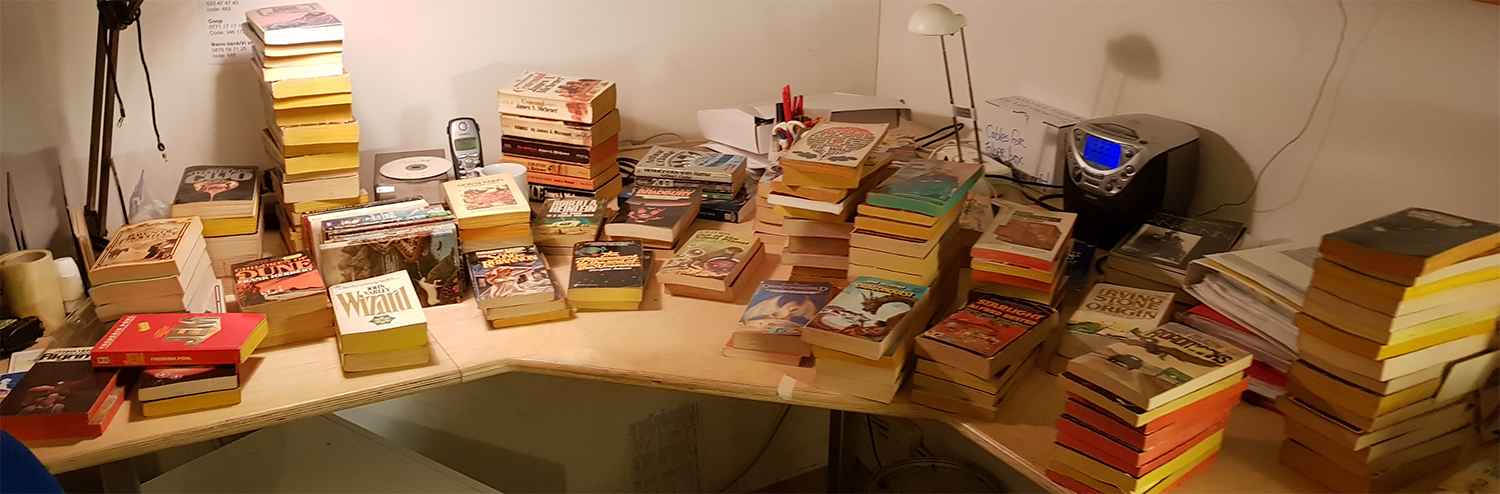
Just some of the books that I have owned

My friend Caroline tagged me in Facebook with her list and I really liked the idea of making the same kind of list. Since the title of this list is “15 Books that Shaped Me” it seems to me that the majority of these books must be ones read early in life and which had a hand in forming the person one turned out to be. I’m no longer quite as formable as I was when I was much younger. But this doesn’t mean I no longer can find books that move me and make me see the world in a different way anymore. They just don’t have the same kind of world shattering effect they had when I was in my teens or 20s.

While how well a book utilizes language is important to me, I generally won’t be judging the quality and technical skill of the writing. But if the ideas or characters or events in the book are so able to move me, to make me think, to leave an indelible mark on me then so who cares if they know where to put their commas and semicolons. The important thing is that the words work.

Some authors write individual books with totally different stories in each, some write many books which inhabit the same universe. Once I enter the universe of an author that I like, I feel great sadness about leaving it and want to keep coming back. So its hard for me to stop at just one book. This makes it also hard to pick out just one book from that universe – I love them all. So some of this list will be more like a series from one author and some will be just individual books.

I had a hard time deciding how I would organize the books. By genre or by when read? I first decided to organize them in a vague timeline. But then I realized that, in reality, my reading generally falls into two categories: Science Fiction and everything else. So I’m going to put the Sci Fi first and then everything else after that. So let’s begin.

Here’s my list:

The Story of Peter and Wendy by James Barry (1911): By the time I was 10, Peter Pan and his Neverland had ceased being just another children’s book for me. They had reached mythical proportions. Peter’s Neverland was the place I tried to get to any time the real world became too hard. I always felt then and probably still do that Wendy was really dumb for wanting to grow up.

The Martian Chronicles by Ray Bradbury (1950): I read this book when I was 11. It was one of my father’s collection of Science Fiction paperbacks. While I understood that it was a chapter book, I was very confused by the fact that each chapter while always about Mars, didnt just follow the previous chapter events. Ray Bradbury himself called it, “a book of stories pretending to be a novel”. Each chapter had different characters and the events took place in unrelated time and space. I had never read a book like that before. The story of the Martian, Tom, a shape-shifter able to take-on the appearance of someone known to the person looking at him has remained with me to this day. While in the town, everyone “Tom” passes sees a person of their own. The Martian, exhausted from his constant shape-changing, spasms and dies. When I read this story I realized you have to be who you are for own self, not try to shift your shape to fit what other people want to see. An idea I still believe to this day.

The Foundation Trilogy by Isaac Asimov (1951, 1952, 1953): I read these sometime in the early sixties when they came, all together in one volume, as a freebee when someone, I don’t remember if it was my dad or brother, joined the Science Fiction Book club. I loved the century spanning scope of it and the way it described individual independence versus the inevitable actions of the masses. I went on to read most of Asimov’s books and in a “Man and His Gods” course in college wrote a very long essay on Asimov’s cosmology using about 10 of his novels. Got a B in the course.

The Lord of the Rings by J.R.R. Tolkien (1954–55): What can one say about LOTR? It is the unparalleled, ultimate Fantasy novel by which every other Fantasy novel is judged. Professor Tolkien didn’t just write a story. He spent his entire life building a world and it shows in every word he put on paper.

Cyteen (1988) and the Chanur novels (published between 1981 and 1992) by CJ Cherryh: Like Isaac Asimov, CJ Cherryh sets many of her novels in the same universe. Cyteen takes place in her Alliance-Union universe, the part of Space known to space-faring humans. Chanur takes place in the same universe but in a region of space in the opposite direction from Earth as the Alliance and Union. The Chanur region is populated by 6 totally alien races mainly unknown to the humans who have traveled out to the other side of Earth. The 6 species trade together under a series of trade agreements called the Compact. (some of the Cyteen and Chanur text is taken from Wikipedia. They do a much better job at summerizing than I ever could. So why reinvent the wheel)
Cyteen is a story about the attempt to clone a brilliant woman scientist who is killed prematurely. Because her own parents, who were also scientists, documented every moment of her childhood, those who wanted to recreate the same person thought if they did everything the same way to the clone they would get the same person. They didn’t get what they expected. A wonderful exploration of human nature set on a different world, in a future time, but still peopled by human beings.
The Pride of Chanur is the first in a series of 5 books. A human exploration ship is captured by one of the more unpleasant alien species. The last human surviver, Tully, manages to find safe harbour aboard the merchant ship belonging to a Hani named Pyanfar Chanur. The entire story is told from the viewpoint of the sleek pelted Hani as they try to understand the strange, bare skined human with a head of golden hair. The realistic handling of linguistic and psychological barriers is one of the stronger aspects of the books. Coercion, manipulation, politics, pride contests, and clashing economic interests as well as species-to-species miscommunication and misunderstanding are just some of the things that make these books so fascinating. Just as Jonathan Swift’s Liliputians were really a commentary on the people of his own time so are all the aliens in Compact space simply human with a twist.

Neuromancer by William Gibson (1984): Fabulous sensory overload about a not so distant future Earth I hope I never have to live in. I’ve also read all his other books.

The Hitchhikers Guide to the Galaxy by Douglas Adams (between 1979 and 1992): Starting off with Don’t panic, this series of books are a wonderfully funny, sarcastic and inventive examination of the nature of humankind. My favorite was Adams’ description of the “Somebody-else’s-problem invisibility shield”. This is a force that operates frequently in my home, especially when applied to dirty laundry on the floor.

Gone with the Wind by Margaret Mitchell (1936): I read this book when I was 16. I loved this book! And the movie was equally great. For many years this book was a bell weather showing how I was feeling about relationships – If I felt the book hinted that Scarlett would win back Rhett, things were good. If things were bad, I was certain she had blown it for good.

Atlas Shrugged by Ayn Rand (1957): When I was 20 years old, Ayn Rand explained the way the world works to me in this book. I recently found my paperback copy from way back then and had the chance to read all the notes I had made in the margins. I’m still looking for John Galt; and Dagny Taggert was one of the first really strong, independent, smart, female roll models I was to run across and look up to.

Doris Lessing: The Golden Notebook, The Martha Quest series, the entire Canopus in Argus series, and the one that had the biggest life/decision effect on me – The Grass is Singing. The moral of the story in the Grass is Singing – never mistake for good, something you know in your heart is wrong for you.

The Prince of Tides by Pat Conroy (1986): I loved the way this novel drew me into it as Conroy bit by bit brings the reader to the explosive core. A wonderful story about the human heart and soul. And the words used to tell it just dissolved in my mouth, melting around my tongue. Just plain wonderful writing.

The Poisonwood Bible by Barbara Kingsolver (1998). An amazing mad journey to the depths of Africa. Bringing Betty Crocker cake mixes.

The Lovely Bones by Alice Sebold (2002). When the book club that I was member of for a short time recommended this book to me by saying it was about the rape and murder of a young teenage girl, I said, “No way, I cant read that”. But I did and could. It describes a type of Heaven that I can live with.

Well, that’s the short list. As usual, I can’t just say a few words when many will do.

just some babble

I don’t know where the time goes. I started this blog because I wanted to have a place to write down the words and ideas that I have circulating around in my head. But, I haven’t posted anything in quite a while. I already have 3 different draft posts on various subjects started, but which I never get around to finishing. From the beginning I wanted to only post full essays, edited, well thought out, and having some sort of point. But, while I start them, I don’t seem to be able to carve out the time to actually finish them. Its probably a matter of discipline. I’m not very good at being disciplined. I always find an excuse to do something else or change my mind or just plain procrastinate. Also, I don’t seem to be able to concentrate on stuff the way I used to. Along with my waistline, my concentration has left the building. It must be part of my control-freak recovery program. Once I decided to stop trying to control everything, I discovered that I couldn’t control anything anymore. I’m beginning to resemble a chicken without a head more and more and feel like I’m sitting in a rubber dingy, floating aimlessly on a small sea. Occasionally, I make land and actually get something done but that is rare. And after I actually accomplish something, it doesn’t take long before I completely forgot what I did. I don’t think its Alzheimers yet. I think even when I was much younger, I had a bad memory for certain kinds of things. But I used to keep a written record of what I had done so I could remember it later. But I don’t write anything down anymore so its as though my memories are now etched in water. Oh dear, it seems that my control-freak recovery program is now also recking havoc with metaphor production.

Now, where was I? Oh yes – writing this blogg. So Ive been thinking that maybe I should set my goal or maybe my aim a bit lower. Not so low that I find myself writing about what I ate for breakfast but maybe just shorter pieces. And they don’t have to actually have a point. Sort of like this piece but maybe more interesting.

Let’s see if that works.

Page 2 of 3

Powered by WordPress & Theme by Anders Norén